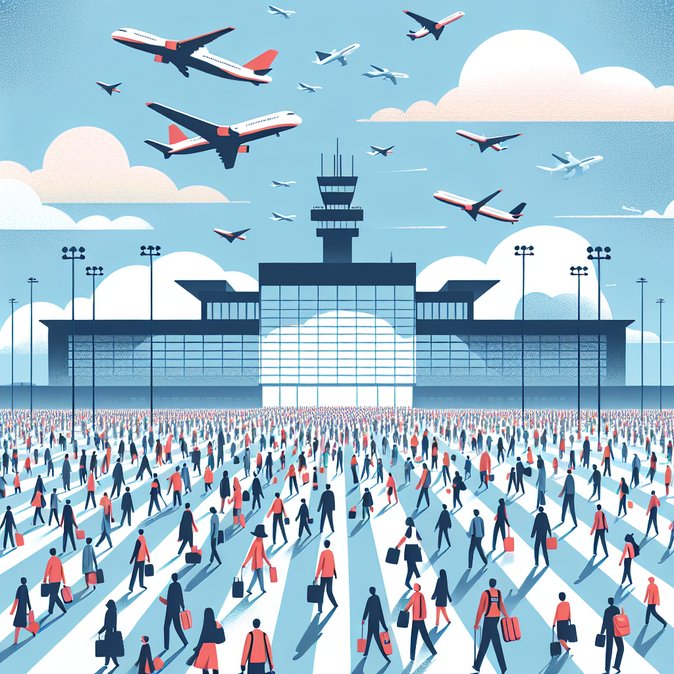
Shanghai Securities News reported on 9 January 2026 that China’s cumulative “aviation population” (the number of people who have flown at least once) surpassed 5 billion in 2025, making it the largest in the world. The milestone—announced at the same civil-aviation work conference—highlights how air travel has become embedded in everyday life and business mobility across the mainland.
Officials credited aggressive airport construction during the 14th Five-Year Plan, including new terminals in Chengdu, Qingdao and Xiamen, plus the maturation of four world-class airport clusters around Beijing-Tianjin-Hebei, the Yangtze River Delta, the Greater Bay Area and the Chengdu-Chongqing economic zone.
![China Becomes the World’s Largest ‘Aviation Population’ at 5 Billion Travellers]()
More than 630 billion yuan (USD 88 billion) has been invested in aviation infrastructure over the past five years. Ninety-three percent of China’s prefecture-level cities are now within a 90-minute drive of a commercial airport, and scheduled flights touch 90 countries and 263 international destinations—critical for multinationals relocating staff or moving components through high-value supply chains.
For corporate travel managers the expanding base means bigger volumes, stronger bargaining power with carriers on negotiated fares, and greater need for traveller-experience differentiation. Analysts expect ancillary-service competition to intensify, with airlines offering bundled Wi-Fi, through-checked baggage on interline itineraries, and carbon-offset packages to win loyalty.
Officials credited aggressive airport construction during the 14th Five-Year Plan, including new terminals in Chengdu, Qingdao and Xiamen, plus the maturation of four world-class airport clusters around Beijing-Tianjin-Hebei, the Yangtze River Delta, the Greater Bay Area and the Chengdu-Chongqing economic zone.
More than 630 billion yuan (USD 88 billion) has been invested in aviation infrastructure over the past five years. Ninety-three percent of China’s prefecture-level cities are now within a 90-minute drive of a commercial airport, and scheduled flights touch 90 countries and 263 international destinations—critical for multinationals relocating staff or moving components through high-value supply chains.
For corporate travel managers the expanding base means bigger volumes, stronger bargaining power with carriers on negotiated fares, and greater need for traveller-experience differentiation. Analysts expect ancillary-service competition to intensify, with airlines offering bundled Wi-Fi, through-checked baggage on interline itineraries, and carbon-offset packages to win loyalty.
Source: Shanghai Securities Daily