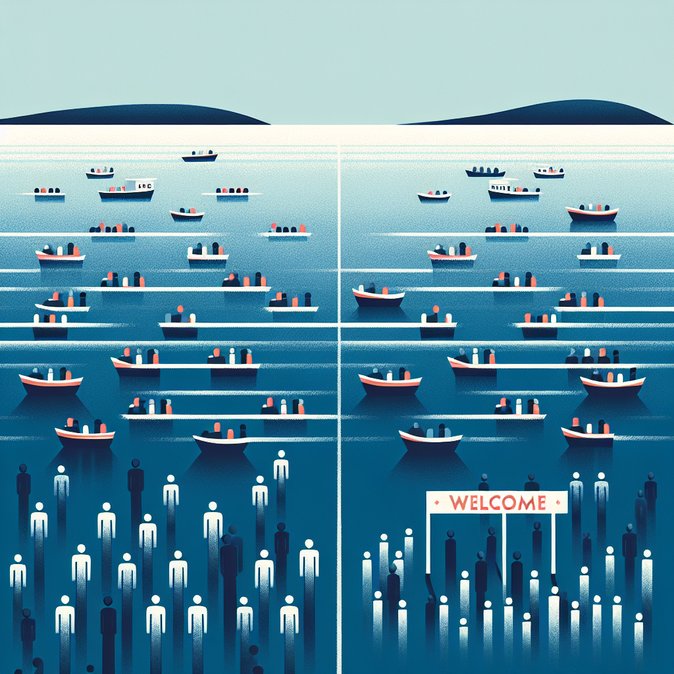
The Italian Interior Ministry reported on 12 January that 229 migrants have landed on Italian shores so far this year, down from 376 in the same period of 2025 and 749 in 2024.citeturn4search0
Guinean nationals made up the largest share (38 %), followed by Sudanese (33 %) and Algerians (11 %). Thirty-six unaccompanied minors were among those rescued. January 2025 ultimately ended with 3,479 arrivals, so officials caution that numbers can climb quickly if weather conditions improve or if Libya and Tunisia relax coastal patrols.
![Sea arrivals fall to 229 in first 12 days of 2026, Interior Ministry data show]()
The lower volume eases pressure on hotspots in Lampedusa and Augusta, where reception centres operated at 160 % capacity last autumn. Nonetheless, humanitarian agencies stress that winter crossings are more dangerous and call for sustained search-and-rescue capacity.
For mobility-programme managers, the data signal fewer immediate delays in residence-permit processing—queues in Sicily are currently under three weeks—but underline the importance of monitoring policy shifts as the government drafts a new security decree. Businesses employing seasonal workers should watch quota allocations closely; lower irregular arrivals often correlate with stricter legal-entry enforcement.
Politically, the figures bolster Prime Minister Meloni’s argument that bilateral deals with Libya and Tunisia are reducing departures. Opposition parties, however, warn that the dip could be temporary and that comprehensive integration policies remain lacking.
Guinean nationals made up the largest share (38 %), followed by Sudanese (33 %) and Algerians (11 %). Thirty-six unaccompanied minors were among those rescued. January 2025 ultimately ended with 3,479 arrivals, so officials caution that numbers can climb quickly if weather conditions improve or if Libya and Tunisia relax coastal patrols.

The lower volume eases pressure on hotspots in Lampedusa and Augusta, where reception centres operated at 160 % capacity last autumn. Nonetheless, humanitarian agencies stress that winter crossings are more dangerous and call for sustained search-and-rescue capacity.
For mobility-programme managers, the data signal fewer immediate delays in residence-permit processing—queues in Sicily are currently under three weeks—but underline the importance of monitoring policy shifts as the government drafts a new security decree. Businesses employing seasonal workers should watch quota allocations closely; lower irregular arrivals often correlate with stricter legal-entry enforcement.
Politically, the figures bolster Prime Minister Meloni’s argument that bilateral deals with Libya and Tunisia are reducing departures. Opposition parties, however, warn that the dip could be temporary and that comprehensive integration policies remain lacking.
Source: AgenSIR