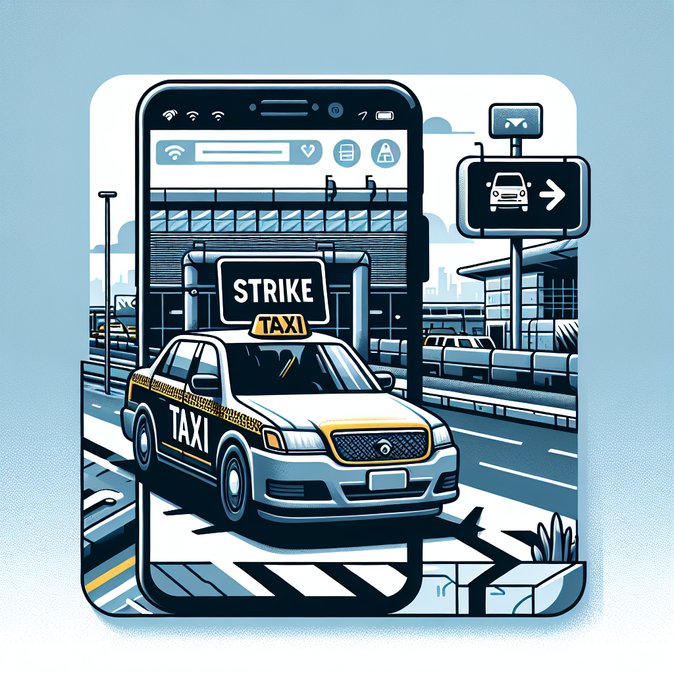
Just hours before a planned indefinite walk-out that threatened to paralyse passenger flows at Cyprus’ busiest gateway, the Pancyprian Federation of Urban Taxis announced on the evening of 26 January that it was ‘calling off, for now’ its strike at Larnaca International Airport. The decision followed an emergency meeting with the Department of Road Transport and assurances that MPs on the House Transport Committee would open formal consultations on ride-hailing legislation next week.
Taxi unions have waged a months-long campaign against what they describe as the “unregulated incursion” of app-based platforms that allow vehicles licensed in other districts—or in some cases private cars—to pick up lucrative airport runs. Drivers say their takings have fallen by 30-40 % as a result. Earlier protests included a 24-hour strike on 20 January that caused lengthy queues for arriving tourists and corporate travellers.
![Larnaca taxi federation suspends indefinite airport strike after government talks]()
For mobility managers the suspension is a welcome reprieve: Larnaca (LCA) handles roughly 70 % of Cyprus’ scheduled international traffic, and a prolonged taxi shutdown would have forced assignees and business guests to rely on infrequent buses or costly pre-booked transfers. Nevertheless, the union warned it would “escalate without notice” if draft amendments do not mandate geo-fencing that stops ride-hailing apps from dispatching non-local vehicles to the airport.
Companies should advise travellers arriving over the coming fortnight to monitor local media and have alternative ground-transport options in place. Employers that routinely reimburse airport transfers may wish to clarify that only licensed taxis (with printed fare tables and roof lights) are eligible for expense claims, reducing the risk of non-compliant receipts if regulations tighten.
Beyond Cyprus, the episode underscores a wider clash between traditional taxi operators and digital mobility platforms at European airports—a trend that can disrupt last-mile travel plans even in otherwise stable destinations.
Taxi unions have waged a months-long campaign against what they describe as the “unregulated incursion” of app-based platforms that allow vehicles licensed in other districts—or in some cases private cars—to pick up lucrative airport runs. Drivers say their takings have fallen by 30-40 % as a result. Earlier protests included a 24-hour strike on 20 January that caused lengthy queues for arriving tourists and corporate travellers.

For mobility managers the suspension is a welcome reprieve: Larnaca (LCA) handles roughly 70 % of Cyprus’ scheduled international traffic, and a prolonged taxi shutdown would have forced assignees and business guests to rely on infrequent buses or costly pre-booked transfers. Nevertheless, the union warned it would “escalate without notice” if draft amendments do not mandate geo-fencing that stops ride-hailing apps from dispatching non-local vehicles to the airport.
Companies should advise travellers arriving over the coming fortnight to monitor local media and have alternative ground-transport options in place. Employers that routinely reimburse airport transfers may wish to clarify that only licensed taxis (with printed fare tables and roof lights) are eligible for expense claims, reducing the risk of non-compliant receipts if regulations tighten.
Beyond Cyprus, the episode underscores a wider clash between traditional taxi operators and digital mobility platforms at European airports—a trend that can disrupt last-mile travel plans even in otherwise stable destinations.
Source: Cyprus Mail