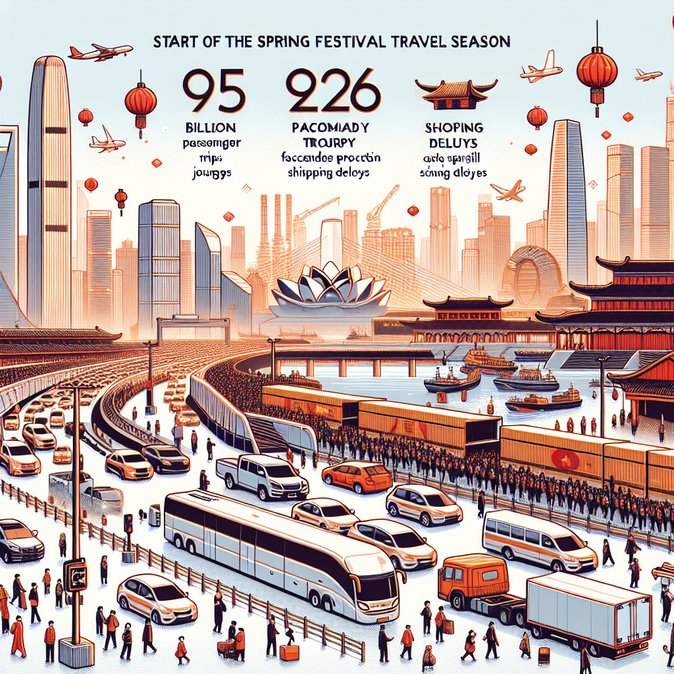
China’s annual 40-day Spring Festival migration—dubbed the world’s largest human movement—officially began this week, and officials expect a record 9.5 billion passenger trips by road, rail, air and water, the National Development and Reform Commission told the Associated Press on 10 February.
The projection eclipses last year’s already-stunning 8.6 billion journeys and reflects a return to pre-pandemic mobility patterns as incomes stabilise and visa-free entry for many foreigners boosts inbound legs. Railway operator China State Railway Group said it has scheduled up to 1,300 extra services per day, while the Civil Aviation Administration of China approved 2,100 additional domestic and international flights during the 2 February–13 March “chunyun” window.
![Record 9.5 billion journeys forecast as China’s Spring Festival travel rush kicks off]()
For global companies, the travel surge is a double-edged sword. On one hand, factory shutdowns and logistics slowdowns can disrupt supply chains; on the other, loosened internal-migration curbs allow millions of migrant workers to reunite with families, sustaining consumer confidence. Multinationals such as Volkswagen and Apple have staggered production cycles and authorised remote work to bridge the two-week peak.
China’s government has rolled out digital ticketing, facial-recognition boarding and expanded high-speed-rail capacity to mitigate congestion, yet videos from Beijing and Guangzhou stations on 10 February showed concourses packed shoulder-to-shoulder. Analysts advise expatriates and business visitors to avoid travel on 15–18 February—considered the “super-peak”—and to secure hotel rooms well ahead, as occupancy in tier-one cities routinely exceeds 95 percent.
The sheer scale of movement provides a live stress-test of China’s upgraded mobility infrastructure, from newly electrified trunk lines to expanded airport terminals. Performance over the next month will influence investor confidence in Beijing’s pledge to build a “national unified market” with frictionless internal circulation.
The projection eclipses last year’s already-stunning 8.6 billion journeys and reflects a return to pre-pandemic mobility patterns as incomes stabilise and visa-free entry for many foreigners boosts inbound legs. Railway operator China State Railway Group said it has scheduled up to 1,300 extra services per day, while the Civil Aviation Administration of China approved 2,100 additional domestic and international flights during the 2 February–13 March “chunyun” window.

For global companies, the travel surge is a double-edged sword. On one hand, factory shutdowns and logistics slowdowns can disrupt supply chains; on the other, loosened internal-migration curbs allow millions of migrant workers to reunite with families, sustaining consumer confidence. Multinationals such as Volkswagen and Apple have staggered production cycles and authorised remote work to bridge the two-week peak.
China’s government has rolled out digital ticketing, facial-recognition boarding and expanded high-speed-rail capacity to mitigate congestion, yet videos from Beijing and Guangzhou stations on 10 February showed concourses packed shoulder-to-shoulder. Analysts advise expatriates and business visitors to avoid travel on 15–18 February—considered the “super-peak”—and to secure hotel rooms well ahead, as occupancy in tier-one cities routinely exceeds 95 percent.
The sheer scale of movement provides a live stress-test of China’s upgraded mobility infrastructure, from newly electrified trunk lines to expanded airport terminals. Performance over the next month will influence investor confidence in Beijing’s pledge to build a “national unified market” with frictionless internal circulation.
Source: Associated Press
How VisaHQ can help
VisaHQ simplifies the visa application process for individuals and businesses. Check current travel requirements, prepare the required documents and manage your application online through the VisaHQ China portal.More From China
View all
China’s major airports log 3,247 delays and 37 cancellations in one day, stranding business and holiday travellers
Thailand Unveils ‘Zhong Tai Yi Jia Qin’ Campaign to Court Chinese Travellers Throughout 2026