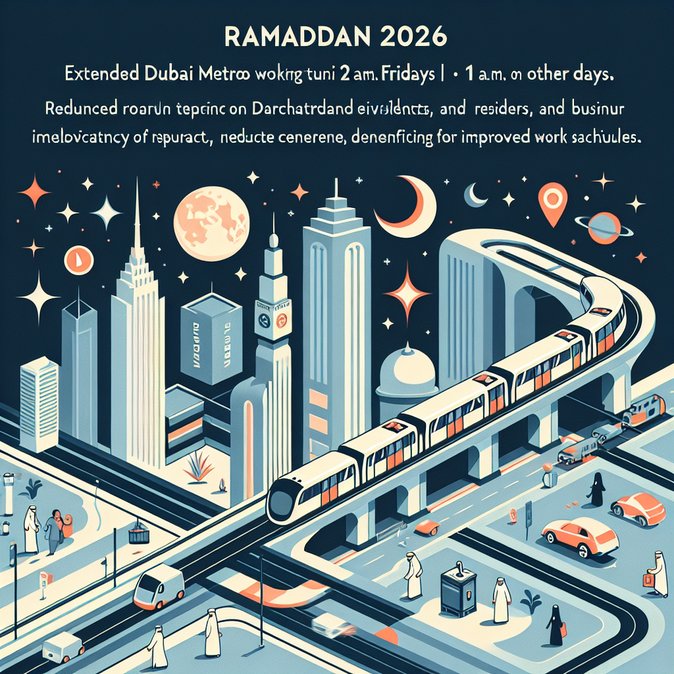
With the holy month set to begin on 18–19 February, Dubai’s Roads and Transport Authority (RTA) has announced a special Ramadan timetable for the Metro that will delight late-night commuters and business travellers alike. From the first evening of Ramadan, trains on both the Red and Green Lines will run until 2 a.m. on Fridays—two hours later than the 2025 schedule—and 1 a.m. on other weekdays.
The move recognises shifting mobility patterns during Ramadan when residents venture out for taraweeh prayers, suhoor gatherings and flexible-hour office shifts. According to RTA data, ridership after 10 p.m. spikes by nearly 40 percent in the first week of the month. The new timetable should ease pressure on taxis and ride-hailing apps while supporting Dubai’s hospitality sector, which expects a Ramadan tourism bump with GCC visitors taking advantage of short-haul flights.
![Dubai Metro Extends Operating Hours and Adds Late-Night Friday Service for Ramadan 2026]()
RTA is also coordinating with Salik to suspend selected toll gates during peak iftar periods and with Dubai Police to manage late-night traffic around major mosques. Businesses scheduling client meetings or crew transfers should note that Metro frequencies will be every six minutes at peak and ten minutes off-peak; last-train departure boards in stations will display real-time updates in Arabic and English.
For mobility planners the practical tip is to incorporate the extended Metro window into airport-to-hotel routings and shift rosters; for assignees observing the fast, it means a safer, cheaper journey home after midnight prayers.
The move recognises shifting mobility patterns during Ramadan when residents venture out for taraweeh prayers, suhoor gatherings and flexible-hour office shifts. According to RTA data, ridership after 10 p.m. spikes by nearly 40 percent in the first week of the month. The new timetable should ease pressure on taxis and ride-hailing apps while supporting Dubai’s hospitality sector, which expects a Ramadan tourism bump with GCC visitors taking advantage of short-haul flights.

RTA is also coordinating with Salik to suspend selected toll gates during peak iftar periods and with Dubai Police to manage late-night traffic around major mosques. Businesses scheduling client meetings or crew transfers should note that Metro frequencies will be every six minutes at peak and ten minutes off-peak; last-train departure boards in stations will display real-time updates in Arabic and English.
For mobility planners the practical tip is to incorporate the extended Metro window into airport-to-hotel routings and shift rosters; for assignees observing the fast, it means a safer, cheaper journey home after midnight prayers.