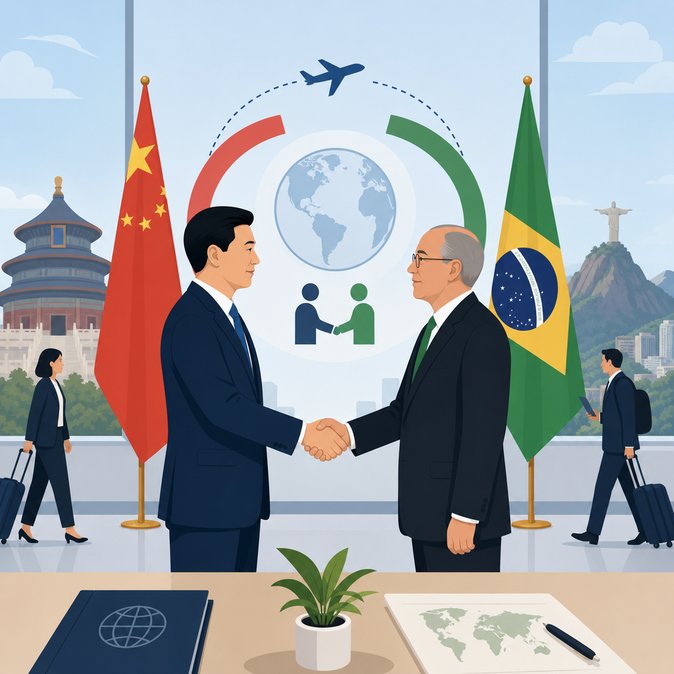
China’s Ministry of Foreign Affairs used its 28 May 2026 regular press conference to announce that Brazilian Foreign Minister Mauro Vieira will visit Beijing from 31 May to 2 June and co-chair the 5th China–Brazil Comprehensive Strategic Dialogue with Wang Yi. While the agenda spans trade and climate cooperation, mobility insiders are watching for progress on the long-mooted mutual visa-waiver deal. Spokesperson Mao Ning emphasised that China and Brazil “have long been at the forefront of South-South cooperation” and will seek to “synergise development strategies.” Brazilian executives in Shanghai told reporters they hope talks will extend the current one-year unilateral visa-free pilot for Brazilian tourists and business travelers, set to expire on 31 May 2026. A reciprocal waiver would remove the need for work-trip invitation letters and cut processing times from two weeks to two days. Chinese outbound investment to Brazil’s renewable-energy and agritech sectors jumped 28 percent in 2025, but HR managers say visa paperwork still slows project deployment. “Every 10-day delay on turbine installation costs us roughly USD 120,000 in idle labour and equipment,” a Guangdong-based wind-power firm told the Global Mobility News desk. A mutual waiver, or at least an extended multi-entry business visa, would shave weeks off site-rotation schedules. Diplomats have flagged people-to-people exchange as a dialogue highlight: Beijing aims to host 20,000 Brazilian students and researchers by 2030, while São Paulo wants to lure more Chinese tech talent into its Semiconductor Super Corridor. Observers expect an inter-ministerial task-force on mobility facilitation, covering e-visa trials, faster airport reciprocity lanes, and joint recognition of vaccination certificates. Any breakthroughs would ripple across multinationals managing talent pipelines between the two largest economies in the southern hemisphere.