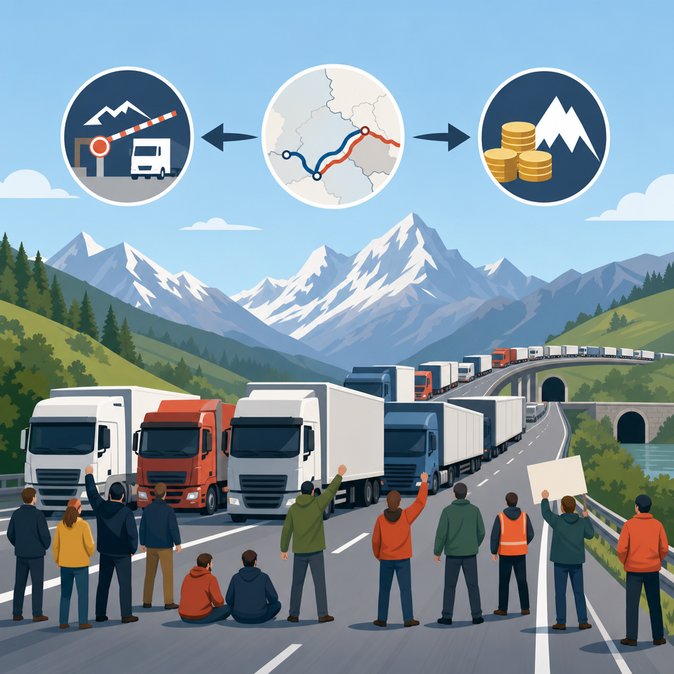
An early-morning convoy of local residents and environmental groups blocked the Brenner motorway on 31 May, demanding that Austria and Italy force freight hauliers back onto rail and share the burden created by Switzerland’s strict Alpine transit regime. Protest leaders accuse Bern of “exporting” truck traffic by capping Swiss motorway slots for non-domestic heavy-goods vehicles and levying one of Europe’s highest kilometre-based tolls. Operators therefore reroute via the Brenner Corridor, funneling up to 9,000 lorries a day through one of the continent’s narrowest Alpine valleys. Switzerland introduced draconian limits in 2001, gradually lowering the maximum number of north-south HGV crossings from 1.4 million to the current ceiling of 650,000 per year and tying road use to the performance-related heavy-vehicle fee (LSVA). The policy has been praised by Swiss voters for protecting air quality around the Gotthard and Lötschberg tunnels, but it has pushed freight forwarders to the only major east-west alternative that is not yet capacity-constrained: the Brenner Pass between Innsbruck and Bolzano. Alpine regions on the Austrian-Italian border now register nitrogen-dioxide levels up to 40 % above EU limits during peak holiday weekends. The demonstrators’ demands echo long-standing calls from Tyrolean authorities for a coordinated, Alpine-wide kilometre toll, night-time driving bans and mandatory rail piggy-backing of certain cargo categories. Vienna and Rome are sympathetic but argue that any common toll must include Switzerland, whose LSVA is already the costliest in Europe but applies only on Swiss territory. Without a harmonised system, freight companies simply pick the cheapest—and currently least congested—crossing, undermining modal-shift objectives spelled out in EU Regulation 2021/1429 on combined transport. Swiss transport minister Albert Rösti reiterated on Sunday that Switzerland “has met its modal-shift target two years ahead of schedule,” moving 74 % of Alpine freight to rail in 2025. He insisted that extending the LSVA beyond Swiss borders would require an EU treaty change that “is not on the table.” Critics counter that Bern benefits twice—cleaner air at home and lucrative LSVA revenues—while externalising pollution and congestion to neighbours who lack comparable trans-Alpine rail infrastructure. For multinational supply-chain managers, the episode is a reminder that regulatory measures taken in one jurisdiction can generate expensive detours elsewhere. Companies moving time-critical goods between northern Europe and Italy should expect sporadic Brenner closures during the summer tourist season and factor in up to six-hour delays or pivot to unaccompanied combined-transport services via Swiss tunnels, despite higher base pricing. Policy analysts say the protests increase pressure for an Alpine corridor agreement that could standardise tolls and night bans across CH, AT and IT—potentially raising transport costs but offering predictability and cleaner logistics in the long run.
Source: Foro3D