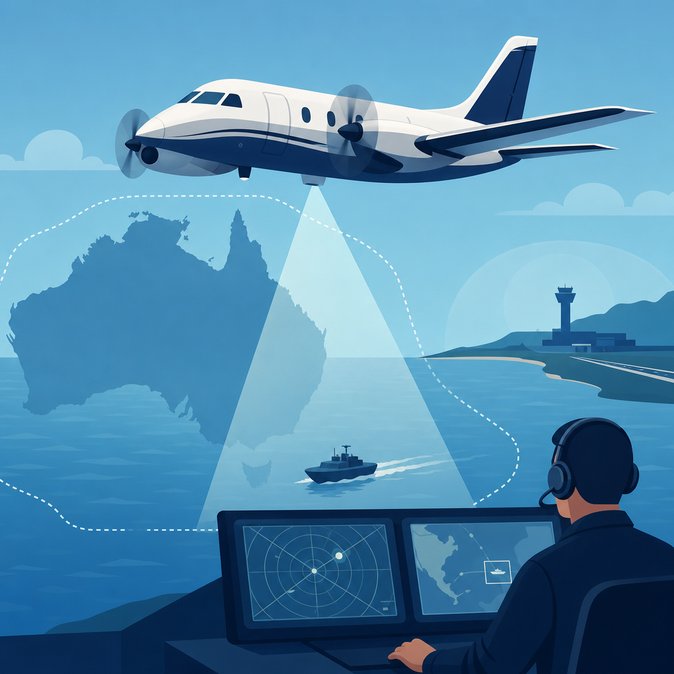
The Australian Border Force (ABF) has awarded a decade-long aerial-surveillance contract to US defence services firm Metrea, replacing the Dash-8 fleet that has patrolled Australia’s northern approaches since 2014. Under the agreement, announced on 2 June 2026, Metrea will supply eight sensor-equipped Beechcraft King Air turboprops and three long-range Bombardier Global 6500 jets, all fitted with maritime-search radar, electro-optical cameras and secure satellite communications. Home Affairs officials said the new mix of short- and long-range aircraft will allow “24/7, weather-agnostic coverage” of priority migration corridors used by people-smuggling ventures, as well as illegal fishing hotspots stretching from the Cocos (Keeling) Islands to the Torres Strait. While the contract does not commence until 1 January 2028, transition teams from Metrea and outgoing operator Leidos will fly side-by-side from Cairns, Darwin and Broome over the next 18 months to avoid surveillance gaps. The deal also includes Australian industry participation: Adelaide-based Cobham Special Missions will provide line maintenance, and Perth’s Sentient Vision will supply ViDAR (visual detection and ranging) software that can autonomously spot small vessels. For global mobility and corporate travel managers, the investment signals that Australia intends to keep maritime borders tight even as skilled-migration and working-holiday quotas rise. Airlines operating to northern gateway airports should expect occasional air-space restrictions during calibration flights, while logistics firms that service offshore energy projects have been advised to lodge flight plans earlier to ensure priority clearance. Immigration lawyers say the contract is also a reminder that enforcement budgets continue to grow; employers hiring crew for coastal shipping or offshore construction should double-check that Temporary Activity (subclass 408) and Crew (subclass 988) visa holders carry evidence of permission to work in Australia’s Exclusive Economic Zone.
Source: PS News
How VisaHQ can help
VisaHQ simplifies the visa application process for individuals and businesses. Check current travel requirements, prepare the required documents and manage your application online through the VisaHQ Australia portal.More From Australia
View all
Government steps up compliance blitz on Pacific Australia Labour Mobility (PALM) employers

Australian Border Force intercepts 34 kg of cocaine hidden in roll-on/roll-off cargo at Fremantle