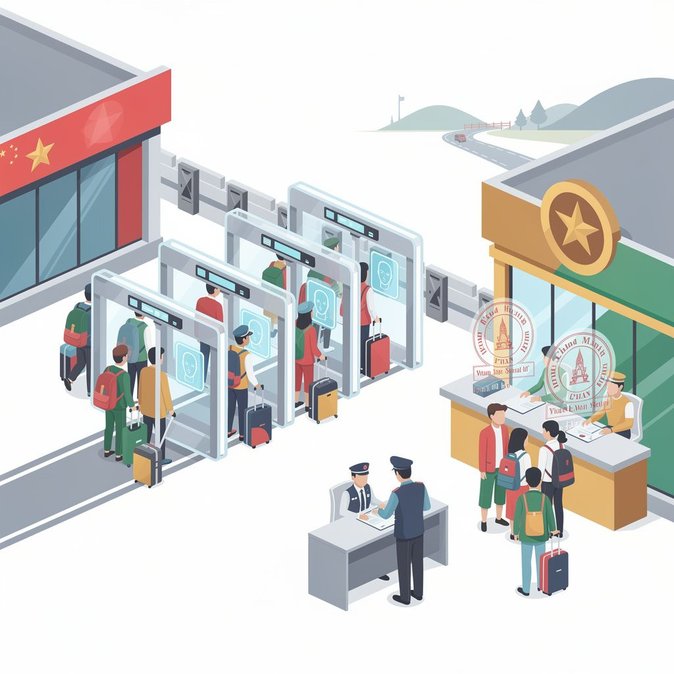
Yunnan’s Ruili border checkpoint—China’s busiest crossing with Myanmar—has processed 3.08 million passenger movements so far this year, the local border-inspection unit confirmed on 7 July. Daily volumes now average 17,000, up 10.8 percent on 2025 levels. Authorities credit a hub-and-spoke model in which the main Ruili post is linked electronically to five secondary corridors, allowing officers to flex staffing based on live crowd-density heat maps. Hardware upgrades include biometric lanes that fuse facial recognition, fingerprints and document scans into a single pass; foreigners can also complete arrival cards online, trimming queuing times by roughly 40 percent. Traffic is diverse: cross-border traders ferry jade, fruit and consumer electronics; ethnic Chinese residents visit relatives; and an increasing number of schoolchildren commute daily for education. The checkpoint has introduced dedicated fast tracks for perishable goods, medical emergencies and Belt & Road project teams—useful for employers moving engineers to hydropower sites in Kachin State. For global mobility teams, Ruili’s resurgence means quicker crew-rotation options for projects in northern Myanmar, where air connectivity remains thin. Companies should nonetheless note that Myanmar’s visa-on-arrival policy for Chinese nationals is suspended until at least October, necessitating advance paperwork on the Myanmar side.
Source: Yunnan Net