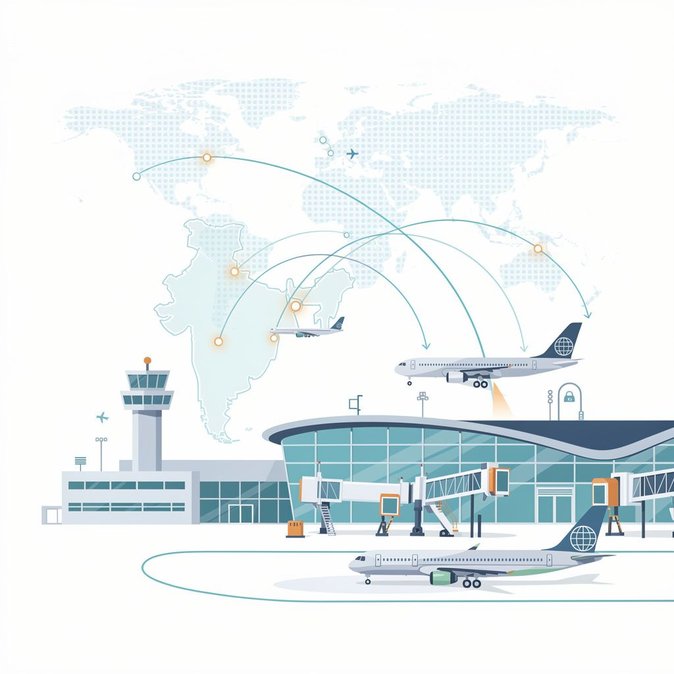
On 11 July, the Ministry of Civil Aviation confirmed rollout details of a hub-and-spoke model that promises to revolutionise how passengers from India’s smaller cities reach the world. Under the scheme—first announced in the Union Budget—travellers flying from tier-II and tier-III airports (the “spokes”) will be able to complete check-in, baggage security, customs and immigration formalities at their origin airport. They will then board a domestic leg to a designated “hub” such as Delhi, Mumbai or Bengaluru, where they will transit air-side directly onto an international flight. For business travellers the gains are obvious: no more chaotic terminal transfers, repeated security screening or long queues at understaffed counters after midnight connections. The Civil Aviation Ministry projects average door-to-door time savings of two to four hours on high-traffic corridors such as Coimbatore-Delhi-New York or Guwahati-Mumbai-Dubai. Implementation is set to begin with six spoke airports—Coimbatore, Lucknow, Guwahati, Jaipur, Trichy and Kannur—linking to the hubs of Delhi and Mumbai from September 2026. New e-gates equipped with the Immigration, Visa, Foreigners Registration & Tracking (IVFRT) back-end will capture biometrics and perform exit-control vetting at the spoke itself. Airlines including IndiGo, Air India and Vistara have agreed to interline baggage through-tagging, while the Central Board of Indirect Taxes and Customs will station officers on a rotational basis to seal duty-paid bags. For corporate mobility managers, the model could unlock talent pools outside metros by cutting the “airport penalty” that often dissuades executives from accepting regional postings. Export-oriented SMEs in Tamil Nadu and Kerala hope faster connections will reduce missed client meetings and cargo delays. Challenges remain: spokes must meet International Civil Aviation Organization (ICAO) standards for secure transit-hold areas, and airlines need robust IT synchronisation to ensure advance passenger information reaches hub authorities. Yet, if successful, India’s hub-and-spoke experiment could become a template for other populous countries juggling airport congestion with regional development.
Source: LiveMint