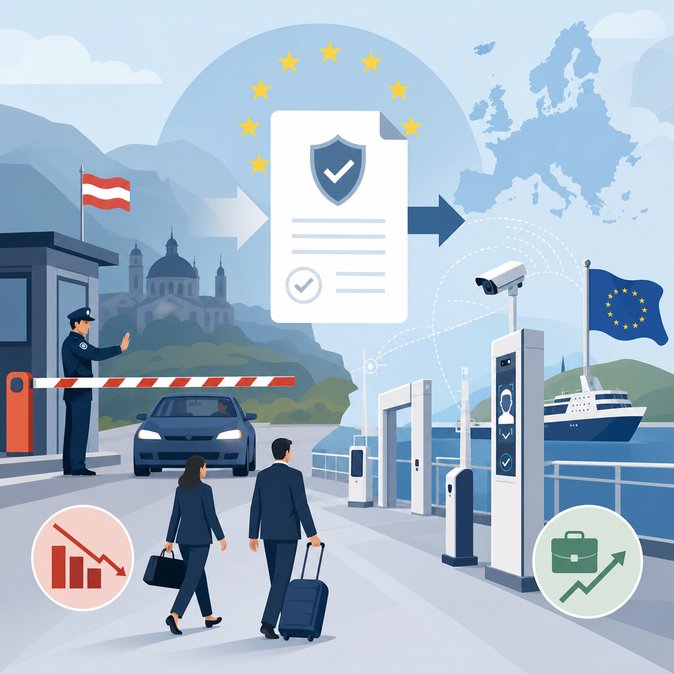
Just hours after the European Commission published its opinions, Austria’s public broadcaster ORF carried a prominent headline—“Appell zu Ende der Schengen-Grenzkontrollen”—placing the issue at the centre of the domestic news cycle. The report highlighted Brussels’ view that alternative measures such as non-systematic police checks and mobile biometric tools would better safeguard security without undermining free movement.
For travellers and businesses that still need to plan cross-border journeys amid such shifting rules, VisaHQ offers a practical lifeline. Through its dedicated Austria portal (https://www.visahq.com/austria/), the platform provides real-time visa and entry guidance for Schengen and non-Schengen destinations alike, helping ensure itineraries remain compliant as policies evolve.
Within Austria, the reaction was swift. The Federation of Austrian Industries (IV) warned that protracted controls jeopardise Austria’s export-dominant economy, noting that two-thirds of the country’s goods trade moves by road through neighbouring EU states. Tourism representatives added that coach operators serving Danube cruises have had to build an extra 40 minutes into Salzburg–Vienna legs when Slovak or Hungarian crossings are congested. Opposition parties seized on the Commission’s findings, accusing the coalition government of “symbolic politics” that hurt small border communities where commuters cross daily for work. Green MP Katharina Plach called for a parliamentary debate before the summer recess and proposed legally capping any future internal checks at 30 days unless approved by Parliament. Interior Minister Gerhard Karner defended the current six-month extension—due to run until mid-September—citing continued secondary migration along the Balkan route. Yet he left the door open to “graduated easing” if irregular-entry numbers stay on their downward trend. Observers say pressure is mounting for a roadmap that balances security with the economic imperative to keep Austria’s borders friction-free.
For travellers and businesses that still need to plan cross-border journeys amid such shifting rules, VisaHQ offers a practical lifeline. Through its dedicated Austria portal (https://www.visahq.com/austria/), the platform provides real-time visa and entry guidance for Schengen and non-Schengen destinations alike, helping ensure itineraries remain compliant as policies evolve.
Within Austria, the reaction was swift. The Federation of Austrian Industries (IV) warned that protracted controls jeopardise Austria’s export-dominant economy, noting that two-thirds of the country’s goods trade moves by road through neighbouring EU states. Tourism representatives added that coach operators serving Danube cruises have had to build an extra 40 minutes into Salzburg–Vienna legs when Slovak or Hungarian crossings are congested. Opposition parties seized on the Commission’s findings, accusing the coalition government of “symbolic politics” that hurt small border communities where commuters cross daily for work. Green MP Katharina Plach called for a parliamentary debate before the summer recess and proposed legally capping any future internal checks at 30 days unless approved by Parliament. Interior Minister Gerhard Karner defended the current six-month extension—due to run until mid-September—citing continued secondary migration along the Balkan route. Yet he left the door open to “graduated easing” if irregular-entry numbers stay on their downward trend. Observers say pressure is mounting for a roadmap that balances security with the economic imperative to keep Austria’s borders friction-free.