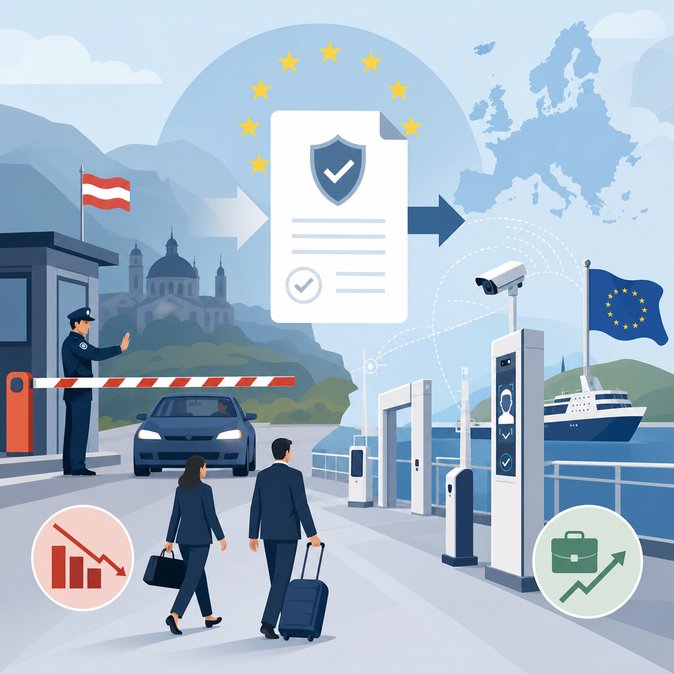
In a set of formal opinions released on 2 June 2026, the European Commission concluded that Austria and eight other Schengen states have not demonstrated that their long-running internal border checks remain strictly necessary. While EU law allows temporary controls in the face of a serious threat, Brussels stressed that many of the measures in place at the Austrian–Slovak, Austrian–Hungarian, Austrian–Czech and Austrian–Slovenian borders have been prolonged well beyond the two-year guideline. Home-affairs commissioner Magnus Brunner argued that the bloc’s new Entry/Exit System (operational since April) and the Migration & Asylum Pact agreed in March give member states “the most advanced external-border toolkit in the world”, making routine internal checks disproportionate. Instead, the Commission recommends mobile, intelligence-led police patrols, biometric spot checks and enhanced information-sharing with FRONTEX. For Austrian businesses the timing is critical. Hauliers estimate that rear-area patrols and temporary barriers add 20–25 minutes to just-in-time truck runs, raising costs for sectors from automotive components to perishable food. Vienna Airport and Vienna Convention Bureau also report that ad-hoc checks on road transfers have prompted several corporate event organisers to route delegates through Munich or Prague instead. The Interior Ministry in Vienna acknowledged receipt of the opinion but said Austria would maintain border controls “until the migratory and security situation allows”. Industry groups—led by the Economic Chamber’s logistics division—have urged ministers to publish a phase-out plan within 30 days to avoid further supply-chain disruption during the summer tourist peak.