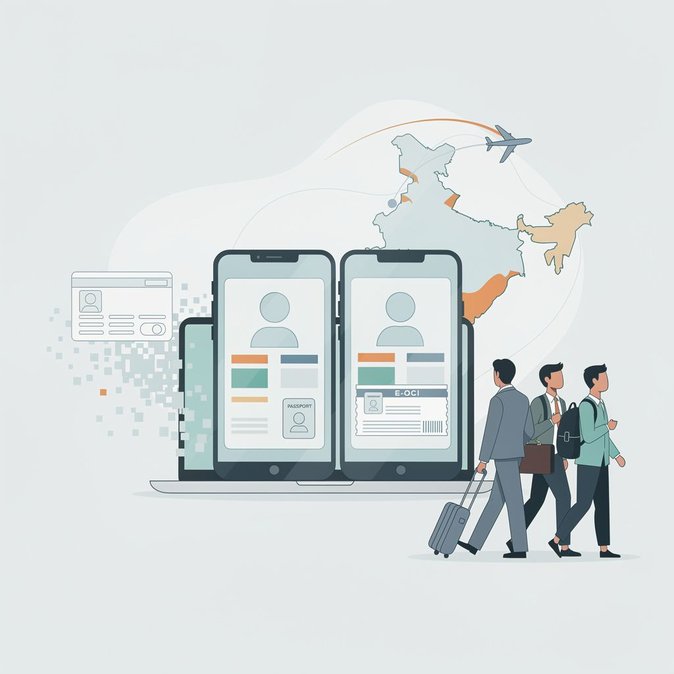
In its latest digital-governance push, the Ministry of Home Affairs on 18 July formally rolled out the electronic Overseas Citizen of India (e-OCI) card, replacing the decades-old booklet and aligning the document with the Immigration, Visa, Foreigners-Registration & Tracking (IVFRT) platform. The digital credential, which can be downloaded from the OCI Services portal or the government’s Su-Swagatam mobile app, carries an encrypted QR code and facial template that can be read automatically at immigration counters and Fast-Track Immigration–Trusted Traveller Programme (FTI-TTP) e-gates. According to officials, more than 5 million existing OCI holders will be invited—free of charge—to convert to the e-OCI over the next six months. New applicants will receive the electronic version by default, eliminating the need to carry a fragile booklet and removing one of the pain points for frequent India-bound business travellers of Indian origin. The change dovetails with the ongoing expansion of FTI-TTP. E-gates equipped with facial-recognition cameras are now operational at 13 Indian airports, cutting clearance times from roughly three minutes to 30 seconds. OCI cardholders, Indian citizens and select diplomatic categories can enrol online and complete biometrics at the airport or at a Foreigners Regional Registration Office (FRRO). For multinational employers, the upgrade promises tangible productivity gains: shorter queues, less documentation to monitor, and fewer missed onward connections for executives shuttling between India and overseas hubs. Travel managers should alert assignees and visiting executives who hold OCI cards to download the digital version and consider enrolling in FTI-TTP to maximise the benefit. Immigration consultants caution that travellers must continue to carry the passport whose number is linked to the OCI record; any passport change still requires updating the OCI database—now an online self-service. Carriers have begun integrating the new QR verification into their departure-control systems, reducing the risk of erroneous boarding denials.
Source: The Financial Express