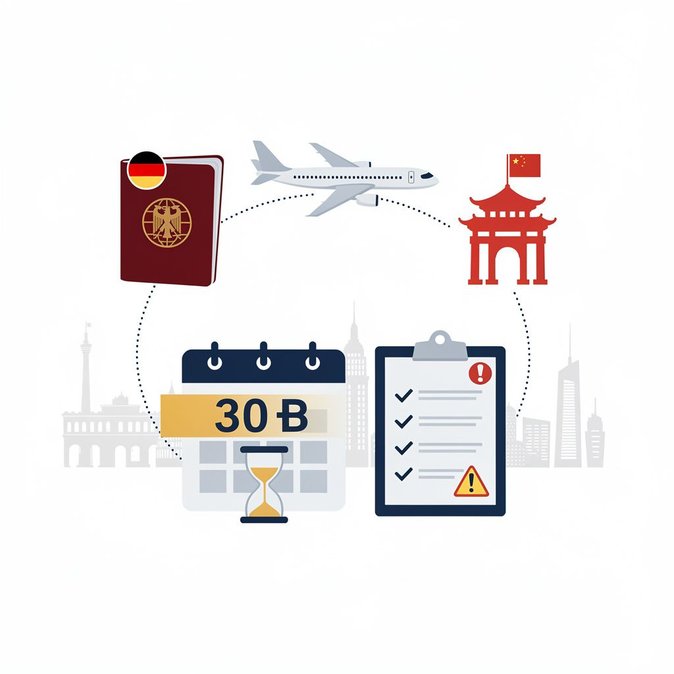
Germany’s Federal Foreign Office (Auswärtiges Amt) quietly updated its travel advisory for mainland China on 20 July 2026. The notice reiterates that, under Beijing’s unilateral visa-waiver scheme, holders of ordinary German passports may continue to enter China without a visa for stays of up to 30 days for business, tourism, family visits, cultural exchanges or transit, provided the trip is completed no later than 31 December 2026. Travellers must still complete the online health and immigration declaration and register with the local Public Security Bureau within 24 hours when lodging in private accommodation. The advisory also reminds visitors that fingerprint collection is standard on arrival and warns that police may impose exit bans on foreigners involved—directly or indirectly—in civil or criminal proceedings. Although the underlying policy is Chinese, a refreshed advisory from a G-7 government matters to globally mobile talent and multinationals. German companies planning short-term assignments, project work, audits or sales trips can continue to deploy staff into China at short notice without the administrative lead time and cost of an M- or F-class visa. The update offers reassurance that the waiver remains in force despite recent geopolitical headwinds, including EU-China trade frictions and the European Commission’s anti-subsidy probes into Chinese EVs. Companies should nevertheless build in compliance steps: employees must carry passports at all times, observe the 30-day limit, and register their address promptly or face fines that could jeopardise future entries. From a policy angle, Berlin’s posting underscores how Beijing is using selective visa liberalisation to revive post-pandemic inbound travel. Germany joins 49 other countries—including France, Australia and most of the EU—in the waiver list. Beijing’s National Immigration Administration (NIA) reported earlier this month that 77.7 % of all foreign arrivals in H1 2026 entered visa-free, a record share. For China-based HR teams, that statistic translates into faster onboarding of overseas colleagues, fewer invitation-letter headaches, and potentially lower relocation budgets. Practical tips: make sure travellers print or screenshot the customs health code before landing, keep proof of onward travel, and advise them that VPN use is technically illegal. Employers should track cumulative days in-country to avoid inadvertent tax residency and confirm that no remunerated work is performed without the appropriate Z-visa and work permit. Finally, remind staff that the waiver is time-limited; unless Beijing extends it again, visa processing will be required for trips planned after 1 January 2027.
Source: German Federal Foreign Office