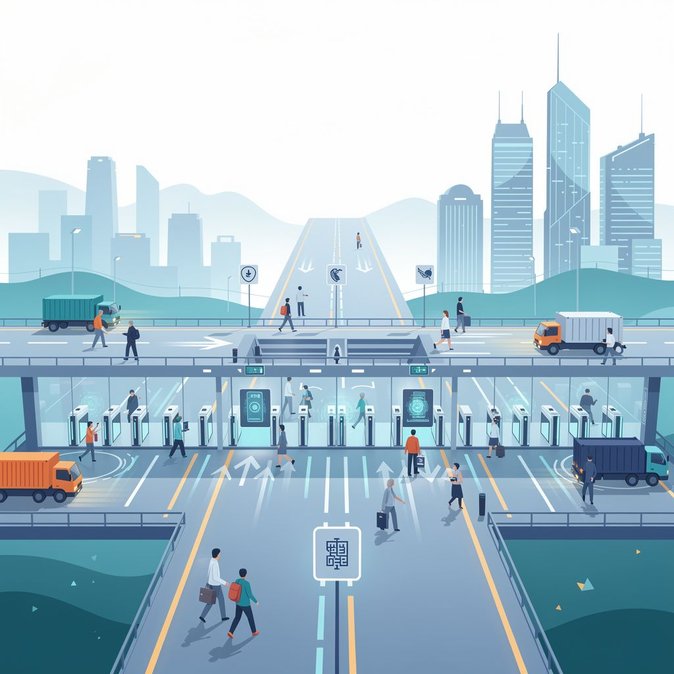
Hong Kong on 20 July gazetted the Huanggang Port Hong Kong Port Area Ordinance, clearing the legal path for a brand-new “co-located” checkpoint that will go live on 31 July. The rebuilt land port—one of the busiest road crossings between Shenzhen and Hong Kong—will adopt the ‘co-operation inspection, one-time release’ model already used at the Hong Kong-Zhuhai-Macao Bridge and the West Kowloon high-speed rail terminus. Under the arrangement, travellers and vehicles clear both Hong Kong and Mainland formalities in a single hall before proceeding, eliminating repeated queuing on the opposite side. Border-control simulations show the average clearance time for private cars and shuttle buses will fall from 30 minutes to about five, while designed capacity jumps to 200,000 passenger movements per day—expandable to 300,000 once the future MTR Northern Link spur line reaches the port. The two governments say the model will be supported by fully automated e-lanes equipped with facial-and-iris biometrics, allowing eligible business travellers and cross-border truck drivers to complete both sides’ checks in under 40 seconds. For companies with manufacturing in the Greater Bay Area, the time savings are significant: logistics firms estimate that same-day return trips between Hong Kong’s container terminals and Shenzhen factories can increase by up to 40 percent, cutting inventory buffers and cold-chain spoilage risk. Commuter coach operators have already applied for 150 additional round-trips per day, targeting office workers who live on one side of the boundary and work on the other. Legal practitioners note that the ordinance affirms the application of Hong Kong law within the designated “Hong Kong Port Area” on Shenzhen soil, mirroring arrangements at the West Kowloon terminus. Compliance teams should therefore review staff-movement policies to ensure awareness of differing legal regimes once passengers exit the controlled zone. Meanwhile, immigration experts anticipate that the border’s throughput will prompt authorities to introduce APEC Business Travel Card fast-lanes and eventually extend the Mainland’s 144-hour visa-transit scheme to cover Huanggang once rail connectivity is in place. The announcement comes amid a broader push to deepen Guangdong–Hong Kong–Macao Greater Bay Area integration and follows last month’s launch of iris-enabled car e-channels at the nearby Shenzhen Bay port, underscoring a region-wide move toward high-tech, high-volume border solutions.
Source: RTHK